
The day after Christmas Day goes by many different names. In a number of European countries it is known simply as the second day of Christmas – you know, the day your true love gives you two turtle doves and a partridge in a pear tree.
Commonwealth countries generally refer to it as Boxing Day and there are plenty of theories about the origin of the name. There was an old English tradition where servants of the wealthy, having waited upon their masters on Christmas Day, were given the following day off to visit their families. As a gesture of goodwill, they were sent off home with a box of leftover food and if they were lucky, a gift or bonus. There’s also a belief that the name refers to Alms Boxes located in places of worship to collect donations for the needy. The donations were distributed to the poor on December 26th each year.
It is often referred to as St. Stephen’s Day because it coincides with the religious feast of St. Stephen; the first Christian martyr who was accused of blasphemy and stoned to death.
But there is another name for this day which is not so well known. In Ireland, while most people refer to it as St. Stephen’s Day, those in the know call it Wren Day, or Lá an Dreoilín in Irish. The wren, known as the king of birds, has long been a symbol of wisdom and divinity. Ancient druids studied their flight patterns and used them to predict future events. In fact, the Irish name for wren, dreoilín, is believed to be derived from two words, draoi ean, meaning Druid bird.
But this poor little bird has been burdened with the blame for some tragic events. One story tells of St. Stephen, hiding from his persecutors in a bush, being betrayed by a chattering wren. Another legend has the wren betraying Irish soldiers during the Viking invasions. As the Irish were sneaking towards a camp of sleeping Norsemen, a wren flapped its wings against one of their shields and another pecked breadcrumbs off a drum, waking the invaders who then defeated the Irish.
Now I’m willing to bet that the dear little wren was stitched up and never betrayed anyone. Both stories may well have been cooked up by early Christians hoping to weaken the power of the Druids, and their beloved druid bird suffered collateral damage in the process. Truth or no, a tradition known as Hunting the Wren (pronounced Wran) began; where Wren Boys would follow and kill a wren on St. Stephen’s Day, parading it through the streets, going door to door looking for a little food or a penny or two, dancing and singing..
The Wran – The Wran – the king of all birds
On Saint Stephen’s Day was caught in the furze
Although he is little his family is great
Come out your honour and give us a treat.
Thankfully, the days of “wren-icide” are over. Nowadays the wren is merely symbolic and the druid bird once again reigns supreme as the king of birds. The most well-known Wren Day takes place in Dingle, but I discovered to my delight another festival that’s been gathering momentum for quite some time in the charming village of Sandymount, just south of Dublin city. I just couldn’t resist popping along this morning to check out the festivities.
The streets surrounding the village green were closed to traffic and thronging with merry-makers. There was poetry, music, dancing and spectacle with the crowning of the ‘Father of the Wran’. Street vendors plated up hot food and surrounding pubs were doing a roaring trade in mulled wine, guaranteed to chase away the winter chill.


The festival-goers were decked out in costumes ranging from Santa hats to intricate concoctions worthy of the Carnival of Venice. Even four-legged revellers got in on the action.
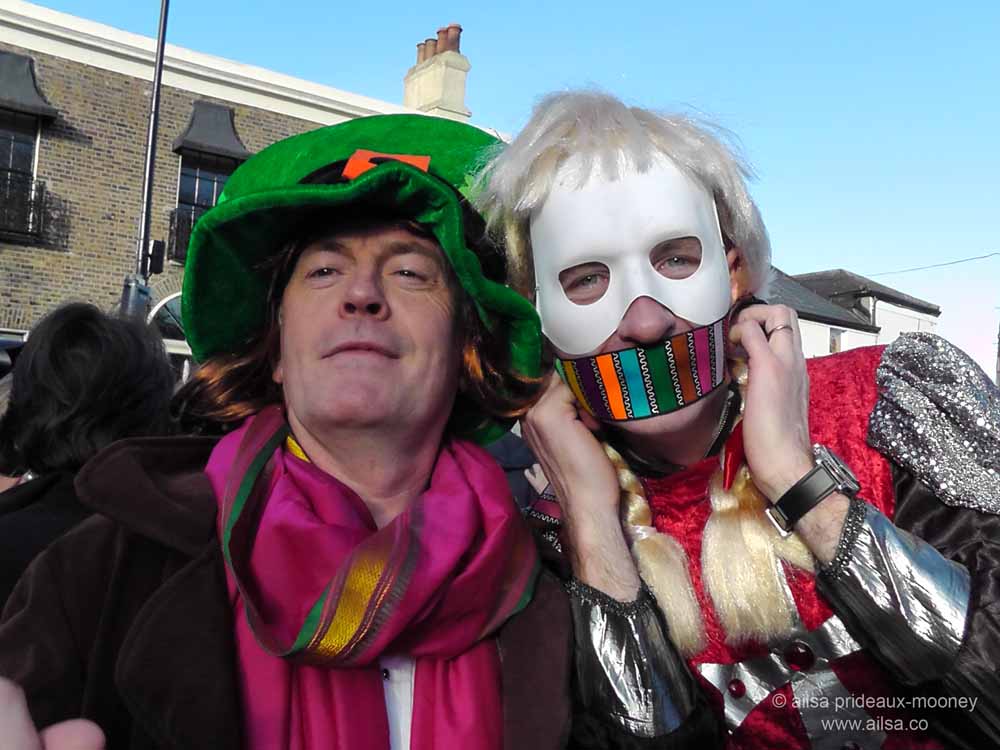



I was dazzled by the gorgeous array of masks on display and felt seriously under-dressed without a mask of my own. Yes, I admit it, I had mask-envy.


I wandered through the crowds taking photos but it wasn’t long before I was whisked up into the arms of a dashing Wran Boy and twirled into the frothy swirl of dancers circling the green. This is a festival where participation is pretty much a non-negotiable. If you don’t believe me, check it out here:
But the highlight of the day came when I got chatting to the Master of Ceremonies, the fabulous Pat McEvoy, who shared with me a few more secrets about the festival, including how the wren became king of all birds, and the meaning behind the festival costumes. Here’s what Pat had to say:
Next year the Sandymount festival will be celebrating its 30th year. If you are in the neighbourhood next Wren Day make sure you go along, and be prepared to dance. I will be back for sure; I’m already looking for a mask to wear. Happy Wren Day!
xxx Ailsa


 Where's my backpack?