
Northwest of Dublin in the county of Meath there is a strange and mystical string of hills known collectively as Sliabh na Cailli, which translates as Hills of the Witch but more commonly referred to these days as Loughcrew. The three main peaks are Carnbane West, Carnbane East (aka Witch Mountain) and Patrickstown and legend calls them The Witch’s Footsteps, for they were created by a witch and giantess who carried boulders in her apron and created these stone-capped peaks by dropping the rocks she carried. In various versions of the legend she either leaps by her own power or jumps on horseback from peak to peak, but all versions end in tragedy when she stumbles and falls to her death at the final peak of Patrickstown.
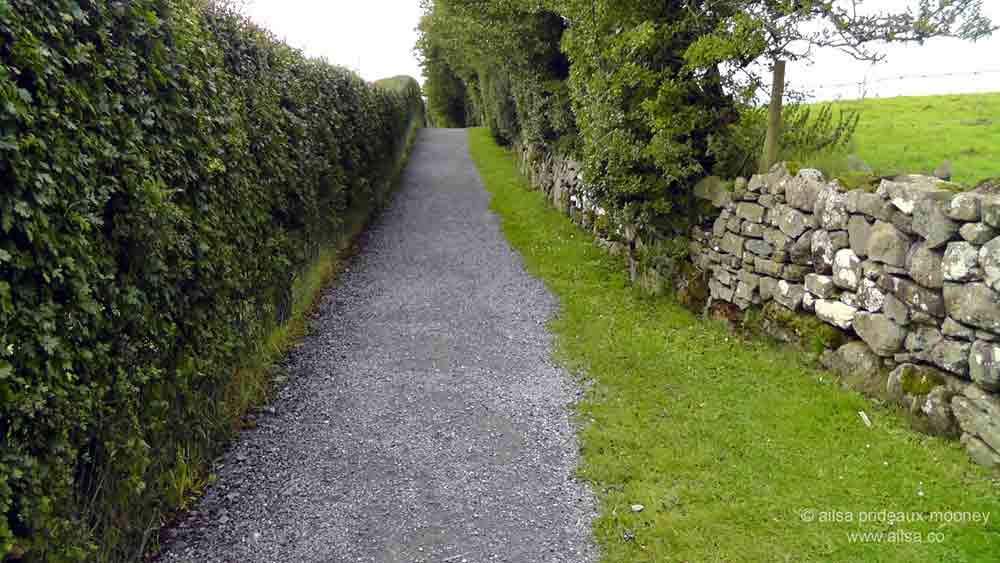
This poor, doomed witch goes by many names. She appears in legends across Ireland, Scotland and the Isle of Man in various incarnations as Mother Earth, the Bringer of Storms, the Moon Goddess and the Goddess of Winter. Her mountains in the northwest of Meath are home to some of Ireland’s most ancient monuments and Stone Age art so it was in this direction I pointed my car one stormy Sunday morning. Loathe as I am to travel by toll roads, I took the scenic route, starting along the M4 west from Dublin instead of the more direct M3, and zigzagged my way northwest along Meath’s back roads. It was plain sailing as far as the castle town of Trim but after that the road quality dropped off and I got to experience the authentic Irish driving ritual of dodging potholes, blind corners and tractor traffic jams through Athboy and on towards Oldcastle. Just shy of Oldcastle I turned up a lane the width of my car and as steep as a cliff face. At the top a small car park with an information sign told me I had reached my destination so I parked and started along a small footpath in search of antiquity.
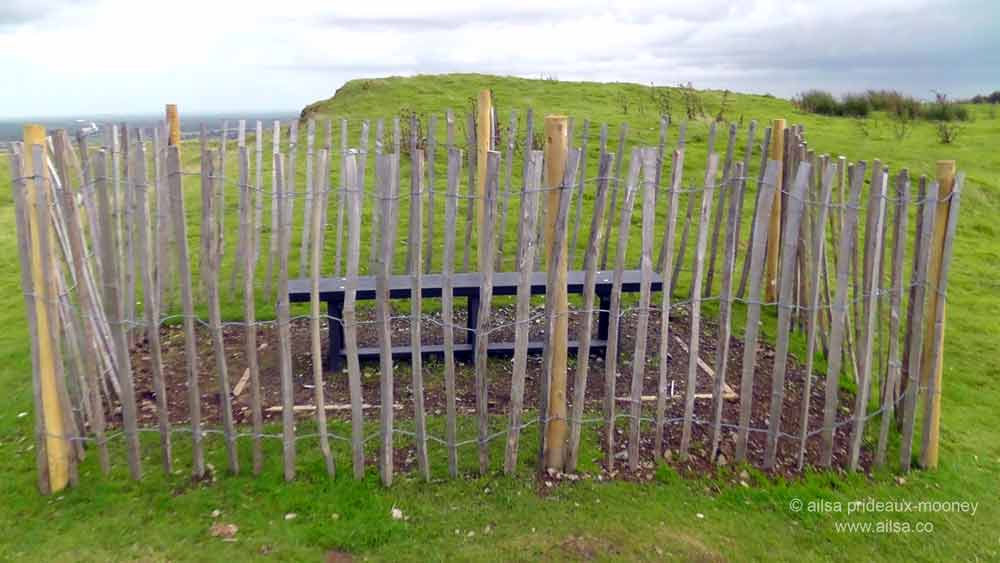
The footpath led to a turnstile that opened onto a seemingly endless meadow. An uphill trail was marked by a series of posts and an OPW (Office of Public Works) sign urged visitors to stay on trail. The incline was enough to raise the heartbeat and a sweat so when I crested the hill I was excited to start exploring, but it turned out to be a false summit. Inexplicably, there was a small wooden bench surrounded by a wooden fence that suggested you had reached somewhere of note, but the only noteworthy thing I noted was the bench and the fence in the middle of a wide open field. Perhaps it was simply a place for weary visitors to rest on their way to the destination proper. I loved the unapologetic oddness of it; it felt intrinsically Irish.
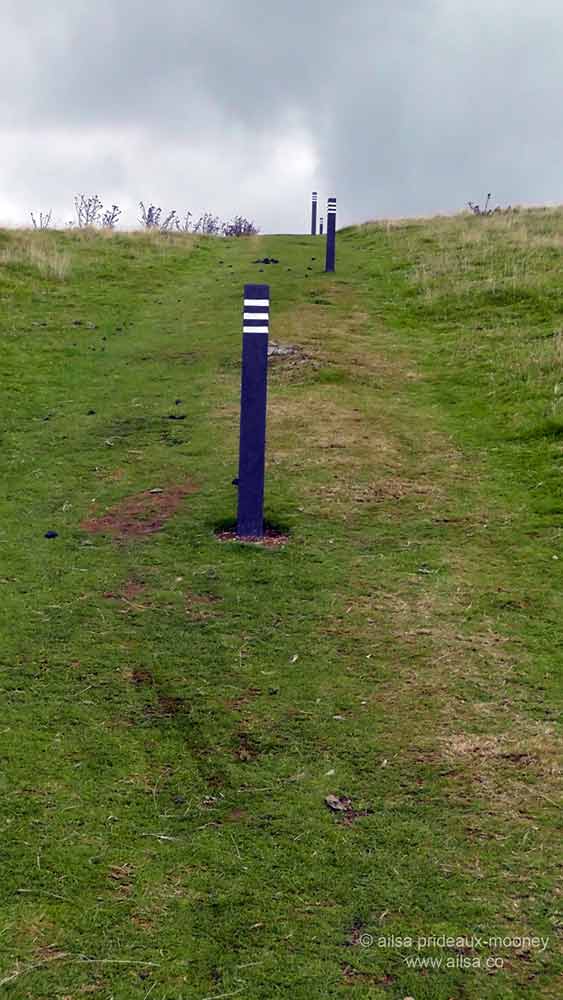
Just past the fenced bench the hill began again with vigour, renewed and even steeper. The trail markers stretched onward and upward and I steeled myself for another climb.
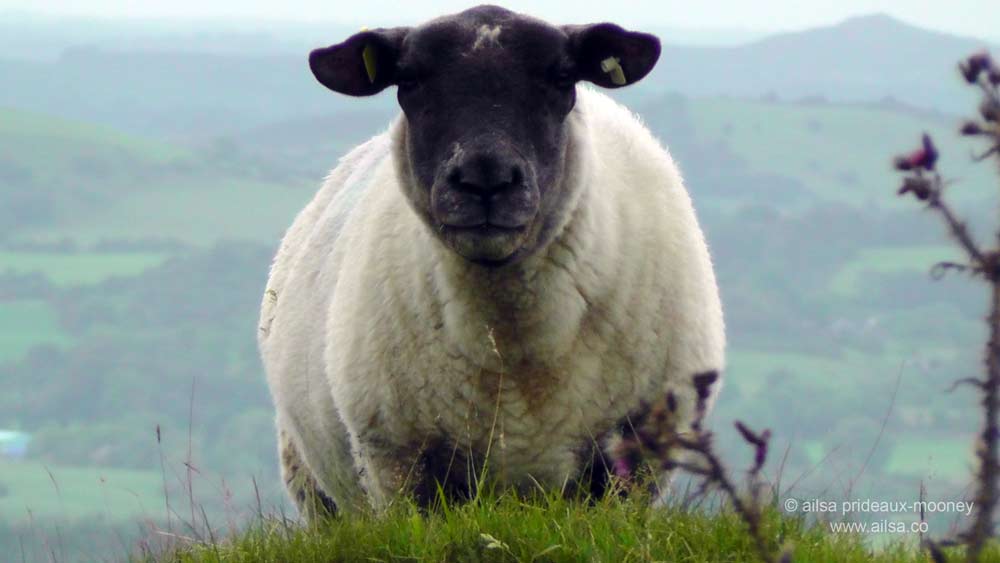
Judgmental sheep mocked my slow progress. They paused their grazing mid grassy mouthful and raised their heads to enjoy the spectacle of me labouring up the steep slope. When I passed by they returned to their lunch with amused smirks on their woolly faces.
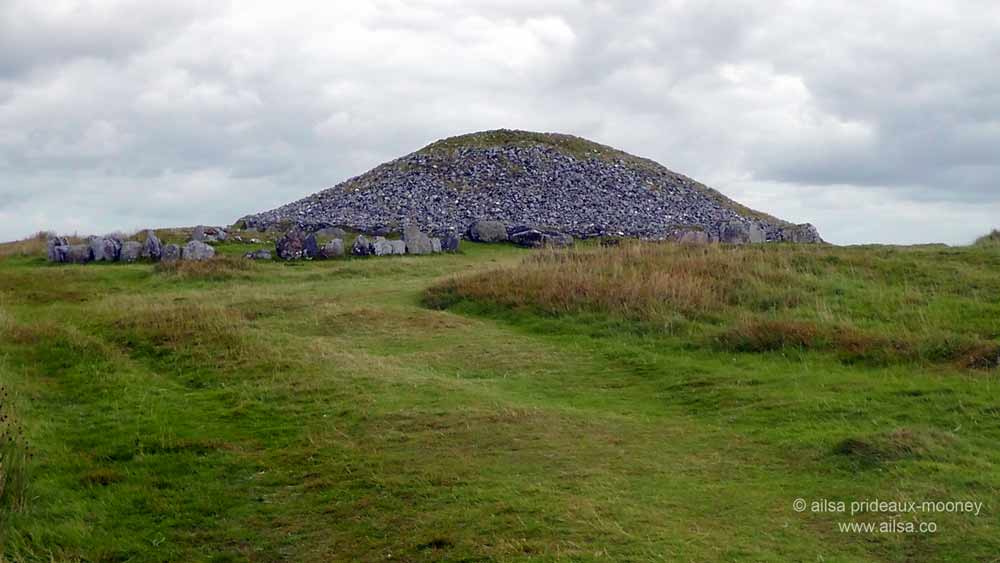
The climb was more than worth it, for at the end of the second incline lay the true summit, topped by a spectacular megalithic cairn dating back to somewhere around 3,500 BC.
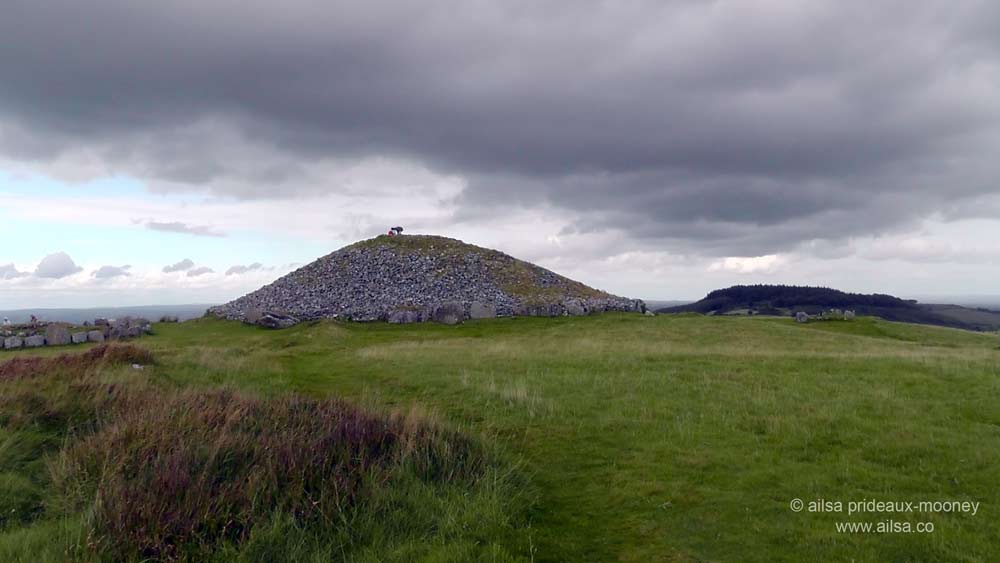
It doesn’t matter if you’ve seen photos or footage or read about cairns like this before; nothing can quite prepare you for the moment when you first come across one of these ancient structures situated in the middle of nowhere. It stops you in your tracks, fills you with wonder and captures your imagination. You are compelled to draw nearer and long to know more of the people who built it. The main structure is circled by six smaller satellite cairns in varying stages of ruin, although all are clearly circular and contain stones covered in neolithic art carved thousands of years ago by Stone Age men and women.
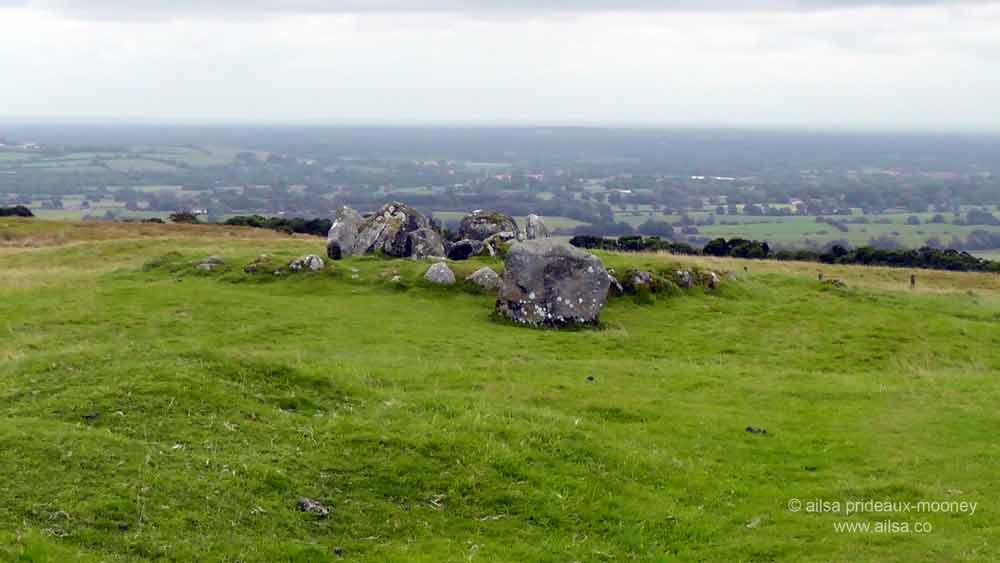
As I drew closer to the main structure the air reverberated with the sound of drum beats. Off to my left a small group of people dressed in brightly-coloured wool sweaters were sitting in the centre of one of the stone circles playing bodhráns, their heads bowed low in studied concentration. A Hollywood film composer would have been hard pressed to find a more perfect musical accompaniment for the approach to this ancient tomb. The rich thunks of the drums ricocheted off the stones and quickened my step. Around the corner a lone woman with grey hair blowing in the wind sat gazing out towards distant hills. She was a guide from the OPW who clearly loved her job. “This is my office” she said, gesturing to the cairn and the surrounding countryside. “I feel pretty lucky”. She gave me a flashlight and let me lead the way into the passage tomb, past heavily decorated stones lined up to create a narrow entrance.
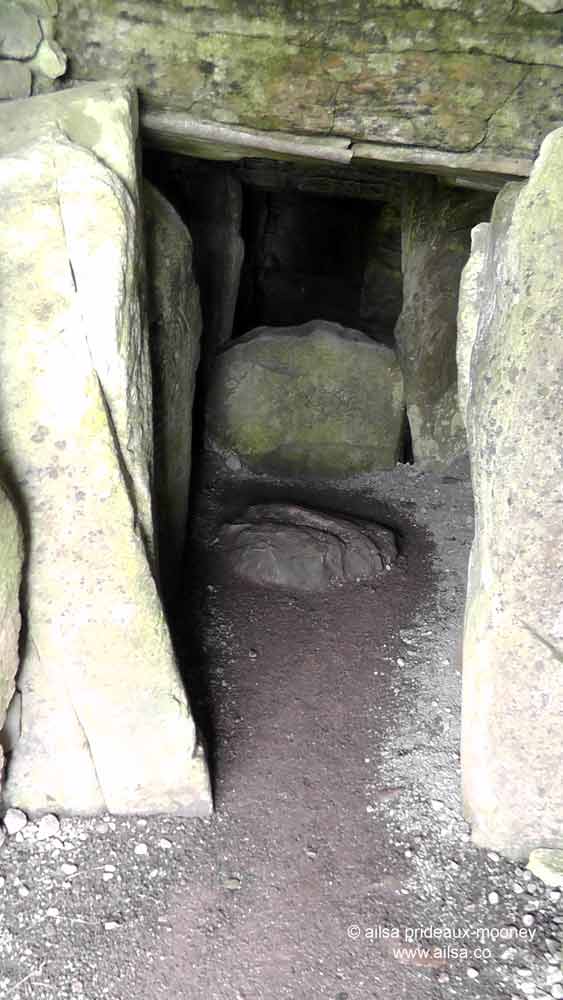
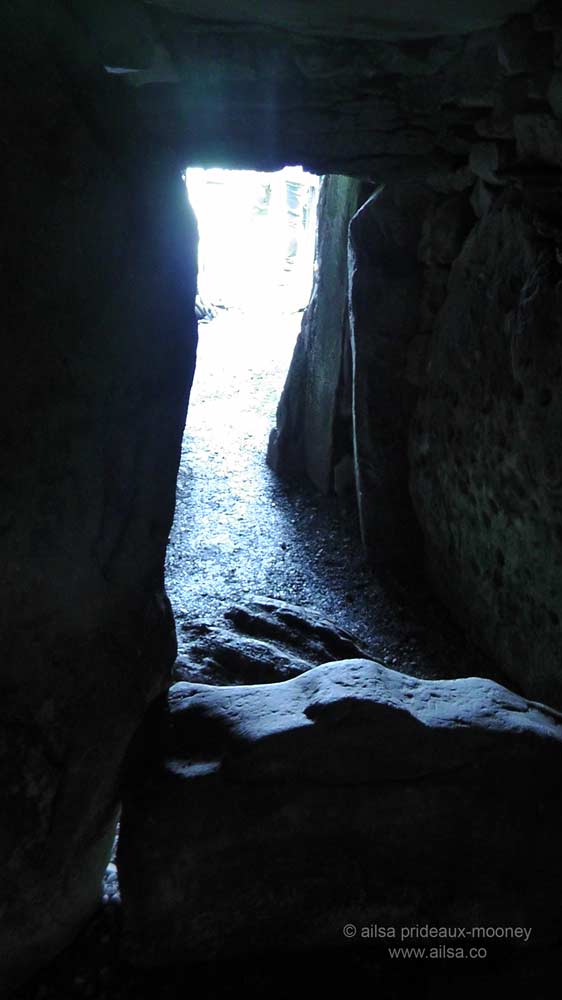
The wealth of ancient art inside the tomb was staggering and the further in I went, the more complex the inscriptions became. Inside the access tunnel I clambered over a waist-high flagstone to reach the inner chamber; a snug cruciform chamber with a corbelled roof and three side recesses, each with its own corbelled roof. The chamber to the west, facing the entrance, was perhaps the most ornate. The roof of the chamber was covered with symbols depicting what looked to me like a representation of the heavens and at the very back of the chamber was a heavily embellished stone referred to as the Equinox Stone.
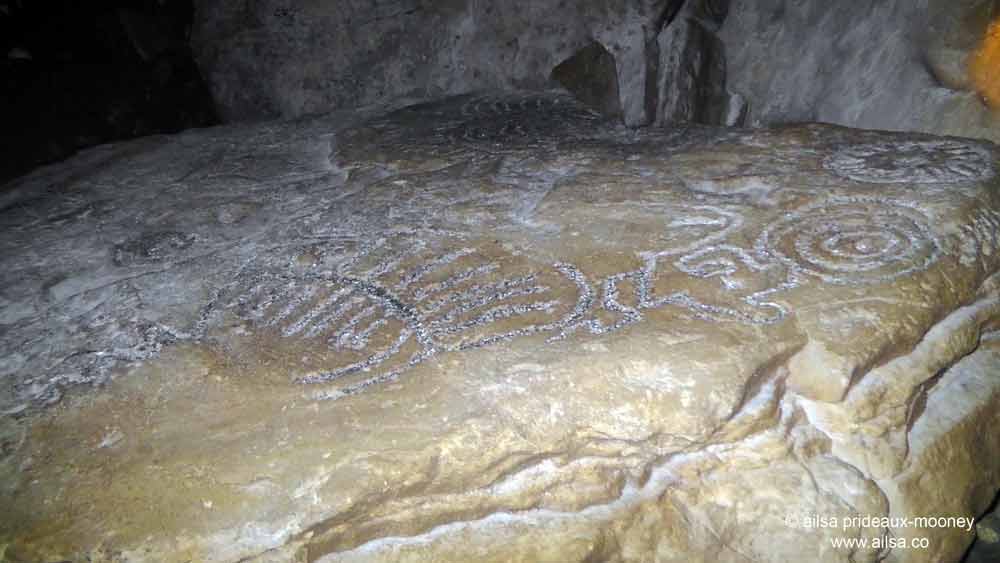
The entrance to the tomb is aligned due east and at sunrise on the vernal and autumnal equinoxes the sun’s rays stream along the narrow passageway and bathe the inner chamber in a golden glow. lighting up the Equinox Stone and tracing an arc across its face. Symbols that look like rudimentary depictions of the sun are etched across the stone and trace the exact route of the sun’s rays on the equinox.
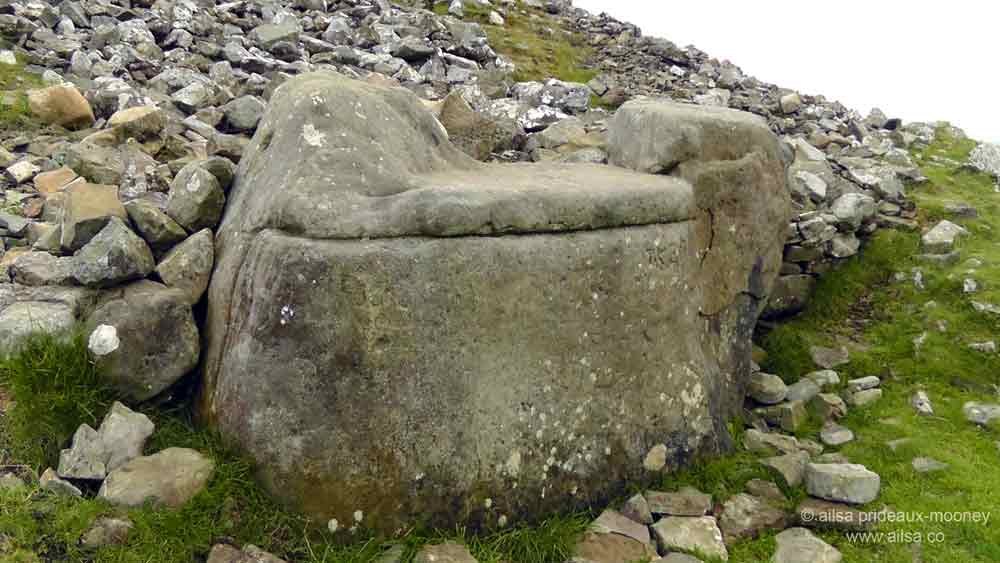
Back outside my guide suggested I take a moment to sit on the Witch’s Throne, a great kerbstone where the witch, sometimes known as Garavogue, was rumoured to sit and gaze out at the stars and the surrounding countryside. It is said she will grant you a single wish if you make the wish while seated upon her throne and then walk clockwise around the cairn.
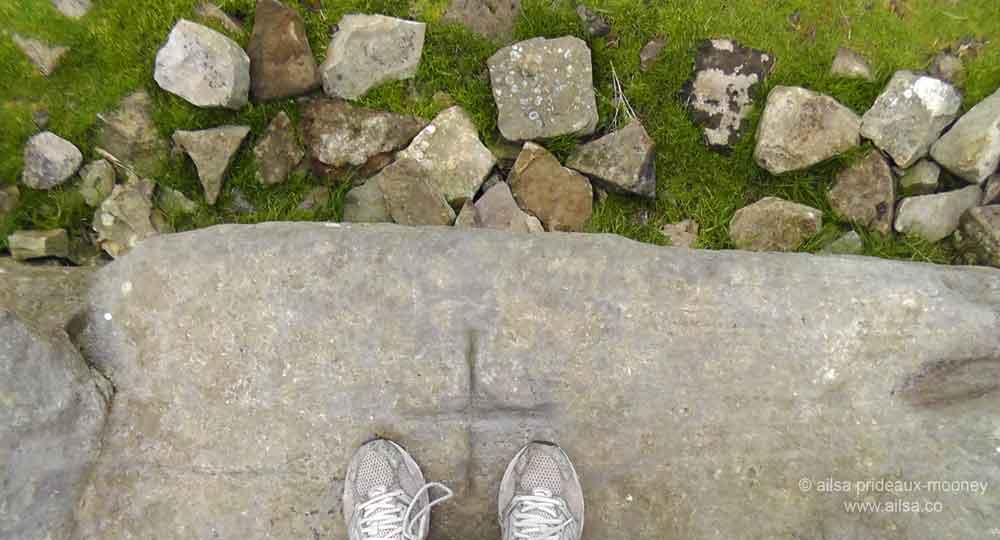
The top of the throne is marked with a deeply etched cross; a much later addition, perhaps dating back to penal times when the rock was used for mass. The stark incisions looked quite brutal in comparison with the neolithic swirls and curlicues from inside the chamber.
Christianity left its mark literally and figuratively on this ancient site. The patriarchal society that Christianity ushered in is also the reason the witch Garavogue was downgraded from female deity to frail old hag in post-Christian folklore. I made my wish to a once fierce and powerful sacred feminine, then circumnavigated the summit. The views are genuinely breathtaking; I defy you to find a better panorama in all of Ireland; on a clear day you can see 18 counties from here.
Here’s a short video of my visit to Loughcrew. I hope you enjoy it, and I hope you get to visit for yourself sometime.
xxx Ailsa


 Where's my backpack?